Shopping Cart
catalog request catalog request
Great tools!
 
Tips

Prosharp Adjustable Side Bevel Guides
On Sale!

This adjustable side bevel guide glides along the ski base on four roller bearings, reducing the chance of imbedding filings into the structure.


Hotronic M4 Footwarmers

hotronic ski boot heater

When your feet are cold it’s hard to enjoy a good day on the slopes. Keep your tootsies toasty. Simply attach the heating elements to your existing footbeds
Check out more ski boot dryers and warmers Here

Prosharp Adjustable base Bevel Guides

A durable aluminum base bevel guide that is adjustable from .5° to 1.5° in .25° increments.


boot Dryers & warmers

ski boot dryers warmers

These sleek boot dryers combine convection heat with forced air to dry and warm your boots quickly and efficiently. Just slip them in your boots and let the quiet fan do all the work . No need to worry about overheating because the warm air is constantly exiting the boot taking moisture with it. The compact size is perfect for travel

More ski Boot dryers and warmers here...


Online Orders received by 10am PST Ship the same day.

Check out our videos on:
how to use our base repair iron to fill a gouge

How to replace a Base section and steel side edge

BASE PREP WAXES

  • New bases, or bases that have just been stoneground, are especially dry, dirty and thirsty.
    Base prep wax is a soft paraffin wax that, when heated, penetrates deeply into p-tex.
  • It should be applied by hot-waxing numerous times before you head out to the slopes.
  • Heat it in and scrape it off immediately (hot-scraping) several times until no more dirt or discoloration appears in the wax shavings.
  • Then apply at least 2-3 more coats, allowing the base to cool completely before scraping and reapplying again.
  • The base should now be ready for hot-waxing with your hydrocarbon wax choice of the day.
  • Base prep waxes are offered by most major wax companies


more on choosing Base Prep Waxing here

Toll Free1-800-299-9904
Hours M-Fri 9-4 Pacific
Fax:(541) 535-7776
International calls (541) 890-5627
Email us : info@tognar.com

request Our Printed Catalog

Get our free 64-page ski and snowboard tuning tool & wax catalog


Win $300 in Ski Wax & Ski tuning Tools!

Send us your favorite ski tuning or snowboard tuning, hot waxing or ski repair tip...and you'll be automatically entered in our annual contest

Mail

Tognar Toolworks
P.O. Box 1453
Phoenix, OR 97535 USA

Ordering and Shipping Details

Domestic & International shipping rates
Expediting orders, delivery times, special Orders,
Return Policy and more...

Toolaholics Reward $aves You Bucks

Earn discounts while supporting your ski and snowboard tuning & wax addiction


This page, and all contents, are Copyright (C) 2009 Tognar Toolworks, Phoenix, OR, USA
Web design and management by
Cat Gould Web Design

Site Map

Online Catalog Listings

About us


Related Ski & Snowboard Links


Why Wax Your Ski or Snowboard?
Back in the early days when all skis had wood bases, skiers had little choice but to wax 'em regularly if they wanted to slide on snow. But along with the introduction of polyethylene bases (p-tex) came the assumption that skis no longer needed waxing. Wrong...p-tex is a thirsty plastic that needs frequent wax feedings. In no time at all, the number of skiers who waxed their skis flip-flopped from 97% who did, to 97% who didn't. And that's pretty much where it remains today... amazingly, only 3-4% of skiers or snowboarders bother to wax their equipment. The performance these folks lose because of this misunderstanding is significant...a waxed base is about 30% easier to turn, more durable and faster than an unwaxed base.

Ski and snowboard bases can easily lose their ability to absorb wax efficiently. The most common cause is simply neglecting to wax regularly. The high friction of snow acts like sandpaper to abrade the ski or snowboard base, wear off wax and leave the p-tex dried out. Another cause is too much heat created by a poor stonegrinding, the use of excessive speed or pressure when rotobrushing, or, most commonly, from an improperly used or uncalibrated wax iron. About half the surface area of most sintered ski and snowboard racing bases will absorb wax when new...these are call "amorphous" regions. Excess heat converts these to "crystalline" regions, which do not absorb wax. Furthermore, heating the ski or snowboard base can increase its oxidation by atmospheric oxygen. Overheating a ski or snowboard base also dries it out and results in the creation of more unwanted, drag-inducing p-tex hairs.

You can help thwart most of these problems. When hot-waxing skis or snowboards, for example, use a decent wax iron that holds a fairly constant temperature (+ or - 8*F). Most household irons don't...they fluctuate wildly in temperature (in excess of 40*F). Secondly, calibrate your iron using one of the thermometers we offer. Third, apply enough wax to the ski or snowboard base so you have a nice molten layer of wax between the iron and p-tex. Don't let an iron come in direct contact with a dry ski or snowboard base. Remember, wax...even the pricey fluoro stuff...is cheap compared to a new pair of skis or snowboard!


Hydrocarbon Waxes

The foundation of most ski and snowboard wax today is paraffin...a hydrocarbon petroleum byproduct that boasts basic hydrophobic (water-repellent) properties. It penetrates deeper into ski and snowboard p-tex bases and lasts longest when melted in using a hot wax iron. Less effective but convenient alternatives are to apply a thin layer of bar wax (like a crayon), then vigorously rub it in with a wax cork...or use a liquid or paste formula (similar in texture to car or shoe polish) that you simply rub on, let dry, and buff off with a clean cloth. ALL-TEMPERATURE (UNIVERSAL) WAXES
For most skiers and snowboarders, the most basic and popular wax is a wide-temperature range universal wax. These are versatile, inexpensive, reliable and convenient for recreational riders, patrollers, guides, instructors and other skiers and snowboarders who commonly encounter a wide variety of snow and/or temperature conditions, and simply need such basic wax benefits as easier turning, decent glide and greater base durability...more than high speed. These ski and snowboard waxes are readily available in bar, paste or liquid form. All major wax companies offer universal hydrocarbon or fluorocarbon universal waxes.
TEMPERATURE-SPECIFIC WAXES

These waxes serve as the foundation for greater performance and racing...and should be the first wax layer you apply to your skis or snowboard, preferably by hot-waxing. They are mixes of high-grade paraffins and other additives that offer greater speed in specific temperature ranges and snow conditions. Depending on your wax brand of choice (we recommend sticking with one initially to simplify matters), you can expect to find from three to five different temperature-range waxes offered by most wax companies, such as:

- Cold wax...for snow temperatures approximately 10*F/-12*C and below. This is a hard wax mix of paraffin and synthetic paraffins...hardening additives that make wax more durable, abrasion-resistant, and immune to scratching by sharp snow crystals (dry friction).

- Midrange wax...for snow temperatures between 10*F/-12*C and 28*F/-2*C. This is a medium wax formulated to counteract the effects of both moderate dry and wet friction.

- Warm wax...for snow temperatures 28*F/-2*C and above. This is a soft wax mix of paraffin and silicone (or similar)...hydrophobic additives that make wax more water-repellent to combat wet friction.

Fluorocarbon Waxes
Since their introduction in 1990, fluorocarbon waxes have proven indispensable at the racing level, where victories are increasingly determined by mere thousands of a second. Accordingly, more junior and master ski or snowboard racers have taken more interest in these pricey but prized speed potions.

WHAT ARE FLUOROS?
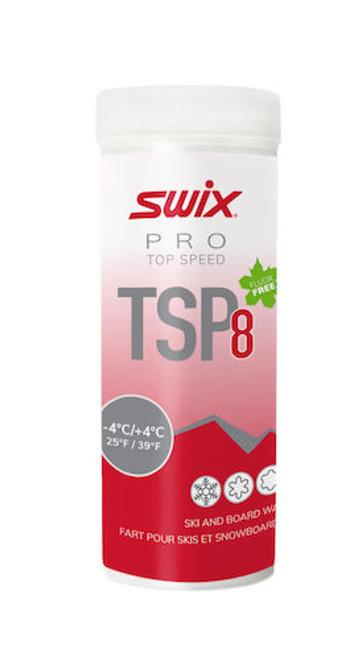
Unlike regular paraffin-based hydrocarbon waxes which are comprised of carbon molecules with neutrally-charged hydrogen atoms, fluorocarbon ski and snowboard waxes are comprised of carbon molecules with negatively-charged fluorine atoms. Somewhat like Teflon, they repel water better by reducing friction (capillary attraction) between bases and water in the snowpack, plus help keep bases cleaner and faster in dirty snow by repelling dirt particles (which, like the fluorine molecules, are negatively-charged). Fluorocarbon ski and snowboard waxes are offered in a variety of both universal and temperature-specific formulations that range from relatively inexpensive low-fluoro wax (1.5-3% concentration for low humidity snow), to mid-fluoro wax (3-5% concentration for mid-humidity snow), to high-fluoro wax (5-15% concentration for high-humidity snow), all the way up to expensive 100% fluoro overlays for top race speed applications. Low-fluoro wax is best suited for dry, low humidity conditions (when it’s hard to make a snowball), mid-fluoro wax is for medium humidity (when it’s easier to pack a snowball), and high-fluoro wax is for wet and high humidity (when it’s easy to pack a wet snowball). Different wax companies have varying but similar standards of humidity levels:

Humidity      Swix        Toko    Dominator  Holmenkol
Low              0-50%       0-40%       0-25%       0-50%
Medium       50-65%     40-70%     25-65%     50-75%
High             65-100      70-100      65-100      75-100%


Since fluoro waxes are available in specific temperature ranges for skis and snowboards, you should always overlay them atop their hydrocarbon wax counterparts. Assuming that humidity levels warrant it (and your budget allows it...since fluoros become increasingly expensive), you should apply consecutive layers of increasing fluoro concentrations over your hydrocarbon wax...i.e.- apply low fluoro layer over hydrocarbon layer, then higher fluoro over the low fluoro layer, etc. Finally, a coat of low-fluoro paste wax applied to ski or snowboard sidewalls and tops can help improve glide when cranking ‘em up on edge for carving turns, as well as helping prevent unwanted snow buildup on topsheets.

100% FLUOROCARBON OVERLAY WAXES
These 100% fluorocarbon overlays are offered in a variety of forms…including powders, blocks, liquids and pastes. A quick review of these top-end products can help you determine which are the most practical, safe, effective and economical to use.

100% FLUORO POWDERS
Powders were the first 100% fluoros to arrive on the ski and snowboard race scene. They require the greatest expertise to apply and are best applied indoors where wind won’t interfere. They’re sprinkled on and spread uniformly over the ski or snowboard base, then lightly tamped down using a hand cork, the palm of a clean hand, or with a heated iron. Then they’re melted into underlying wax layers (which, for best results, should include low, medium and/or high fluoro-concentrate waxes appropriate for your snow conditions) using either a hot wax iron or cork. Using an iron to melt in these overlays yields the greatest durability, but also requires very careful attention…especially since the temperature necessary to melt fluoro powders is hot enough to burn a ski or snowboard race base, as well as potentially create lung-damaging fumes. Although traditionally utilized by experienced technicians for maximum wax durability on long icy World Cup speed courses and nordic races 25K or longer, it’s an unnecessarily risky application for most juniors, masters, coaches or parents to attempt. A safer alternative is to use a hand or rotocork to rub and melt overlays into ski or snowboard bases. Using a hand cork powered by lotsa elbow grease...or an electric drill to spin a rotocork...they create heat via friction to melt fluoros into the base. Although they don’t generate temperatures as high as an iron to yield equally durable results, corks effectively bypass the safety and health concerns of ironing, while still providing the same fluoro speed benefits, which is ideal for juniors and masters who rarely race on courses as long, hard or abrasive as World Cup ski and snowboard competitors. Powders aren’t cheap. World Cup service techs use ¼ to ½ ounce on each pair of skis or snowboard, regardless if they iron or cork it in. At retail, this translates into $25-$60 per application…a hefty price for even top racers.

100% FLUORO BLOCKS
More recently, 100% fluoro blocks were introduced. These are 100% powders which are poured into a mold and compressed under extreme pressure (1000+ pounds). This process not only transforms them into solid form, but crunches fluoro particles into a smaller size which melts into bases at a lower temperature than powders. Fluoro blocks are applied to ski or snowboard bases by rubbing them on by hand like a crayon. A thin uniform layer is adequate to melt it in with a hand or rotocork, whereas a thicker layer is needed for ironing to avoid the risk of accidentally burning bases.For this reason, ironing in block overlays is advised only for long nordic races (25K or more) where maximum durability is required. Otherwise, hand or rotocorking is safer and equally effective for junior or master racers in all other events…and has likewise gained increased popularity on the World Cup, especially for technical alpine events. Corking in these fluoro blocks